
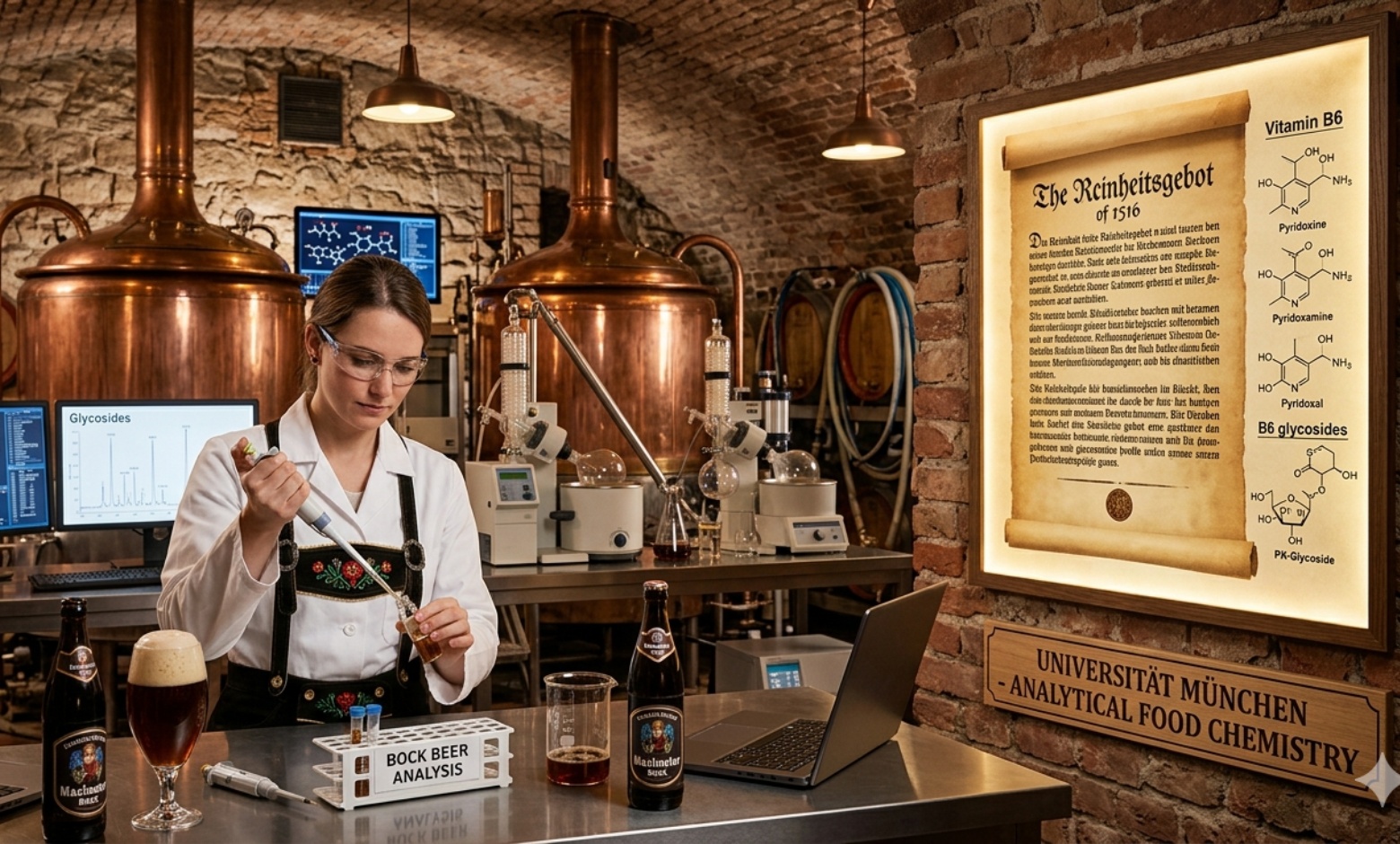
Whether you are justifying a post-work pint or looking for a reason to reach for a non-alcoholic lager, the “liquid bread” moniker just got a scientific upgrade. A new study published today in the Journal of Agricultural and Food Chemistry suggests that beer serves as a substantial dietary source of Vitamin B6, an essential cofactor for enzymes that keep your metabolism and nervous system from grinding to a halt. While we’ve long known beer contains vitamins, this research provides the most granular look yet at how much “B6 potential” is actually sitting in your glass.
To get these results, researchers at the Technical University of Munich analyzed 65 different German beers using a sophisticated new method they developed called SIDA LC–MS/MS, which allows for the native quantification of seven different “vitamers” (forms of B6) and their sugar-bound cousins. The numbers are surprisingly robust for the average drinker: a standard serving of lager (250 mL for women, 500 mL for men) provides approximately 9.2% of the recommended daily intake for women and a solid 16% for men. It turns out that ordering a second round might just be a nutritional strategy.
However, not all beers are created equal in the eyes of the vitamin gods. If you are drinking for efficiency, the heavy-hitting Bock beer reigns supreme, boasting the highest B6 concentrations of all styles tested. Conversely, wheat beer fans may be disappointed to learn their choice has significantly lower B6 levels than a standard lager. The real “alcohol-free surprise,” however, lies in the chemistry of sobriety. Alcohol-free beers were found to have five times the concentration of B6 glycosides (vitamin B6 bound to sugar) than their full-strength counterparts. The researchers suspect a “yeast tax” is at play; in regular beer, the fermentation process allows yeast to degrade these healthy complexes. Because alcohol-free versions often use suppressed fermentation, those nutrients remain intact. To settle the score, the authors propose further study into whether the type of yeast—specifically the drama between top-fermenting and bottom-fermenting strains—changes the final vitamin payout.
Naturally, the researchers didn’t miss the opportunity to wrap their findings in a bit of national pride. The study explicitly notes that all samples were brewed according to the Reinheitsgebot, or the “German purity law,” which they helpfully remind us is the world’s oldest food act. While it is certainly commendable that the University of Munich team stuck to their local roots to ensure scientific consistency, there is something undeniably charming about a high-tech laboratory study doubling as a love letter to Bavarian brewing standards. Apparently, if you want the best B6 results, you’ll have to stick to the German tradition—purely for the sake of science, of course.