
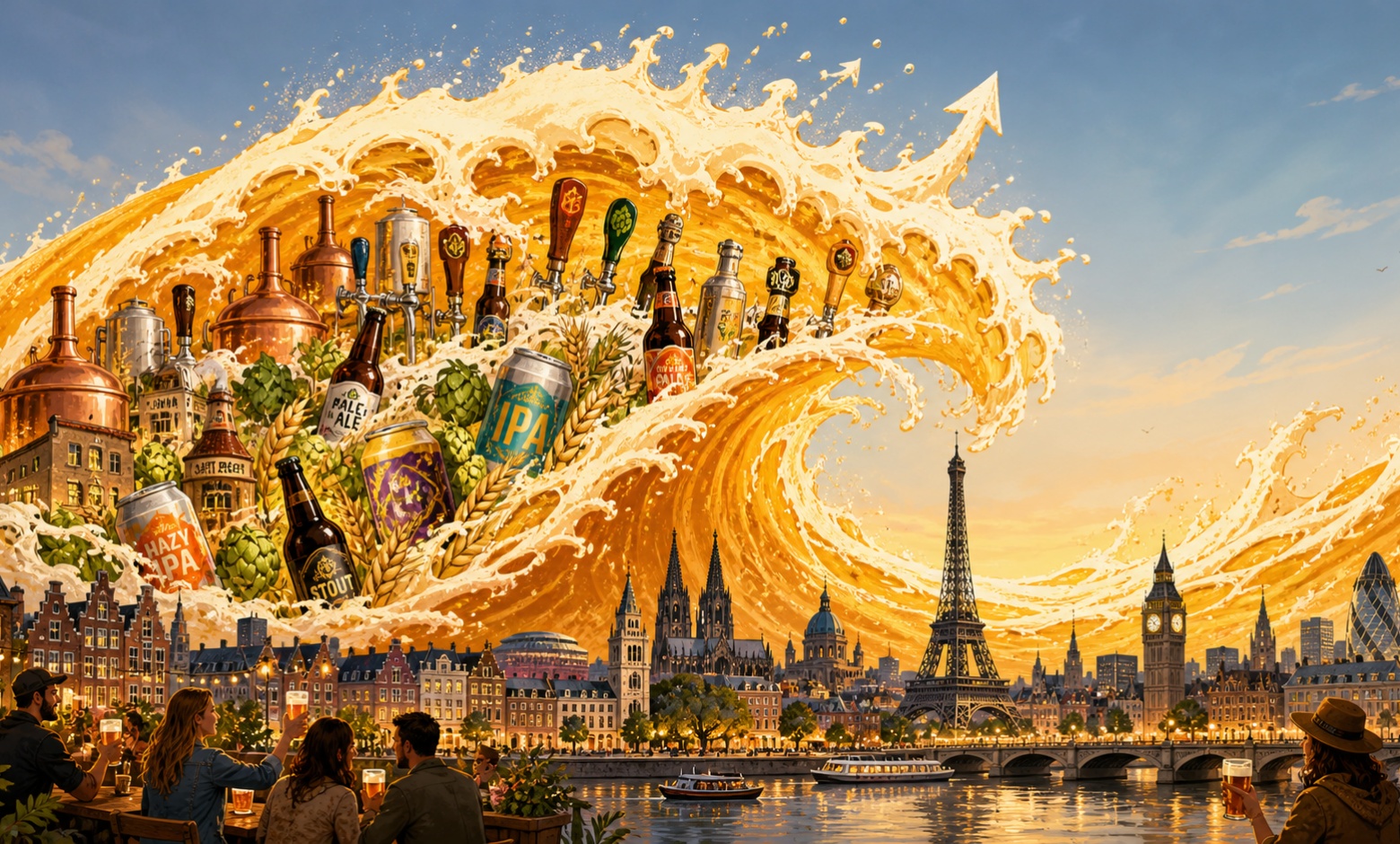
A new analysis of the European craft beer market suggests that the continent’s thirst for artisanal brews is evolving from a localized trend into a heavyweight economic sector. According to a report by the IMARC Group, the European craft beer market reached a valuation of USD 42.7 billion by 2025. This trajectory is expected to continue upward, hitting USD 73.2 billion by 2034, representing a compound annual growth rate (CAGR) of 6.18%.
While this growth is robust, it places Europe in an interesting middle ground within the global landscape. The European CAGR of 6.18% comfortably outpaces the 5.86% projected for the U.S. market, yet it remains more conservative than the global beer market’s projected CAGR of 8.2%. It appears that while the “craft” might be disappearing into corporate portfolios elsewhere, the European market is focused on scaling its established players.
Germany Commands the Continent
The regional data reveals a clear hierarchy, with Germany currently commanding 28.4% of the European craft beer market. There is a certain irony in the fact that the ancestral home of the Reinheitsgebot—a purity law not exactly known for encouraging experimental additions—is now the primary engine of a movement defined by stylistic boundary-pushing.
France follows as a significant competitor, proving that the traditional “wine belt” of Europe is increasingly susceptible to the charms of high-alpha hops. This regional rivalry is driven largely by rapid urbanization and a shift in consumer demographics; rising disposable incomes are being funneled toward premium, “authentic” products rather than mass-produced lagers.
Drivers of the Craft Pivot
Several key findings highlight why the market is expanding despite broader economic fluctuations:
- The Ale Dominance: The Ale segment remains the market’s primary driver. Consumer preference for diverse, complex flavor profiles continues to favor top-fermented styles over traditional bottom-fermented staples.
- Premiumization and Sustainability: Consumers are increasingly viewing beer through the same lens as fine wine or specialty coffee. This “premiumization” is coupled with a demand for sustainability, where organic ingredients and eco-friendly production methods are no longer optional extras but baseline expectations.
- On-Trade Vitality: While retail and online sales (off-trade) remain steady, the “on-trade” experience—bars, taprooms, and restaurants—remains the essential theater for brand discovery and consumer loyalty.
The competitive landscape is also shifting. Major global entities like The Boston Beer Company and Anheuser-Busch InBev are navigating a space increasingly crowded by independent microbreweries. For the independent brewer, the challenge remains scaling without losing the “craft” identity that justifies the premium price tag.
As Europe marches toward that $73 billion milestone, the question remains whether the market will maintain its diversity or if consolidation will eventually turn the “craft revolution” into just another corporate balance sheet.