
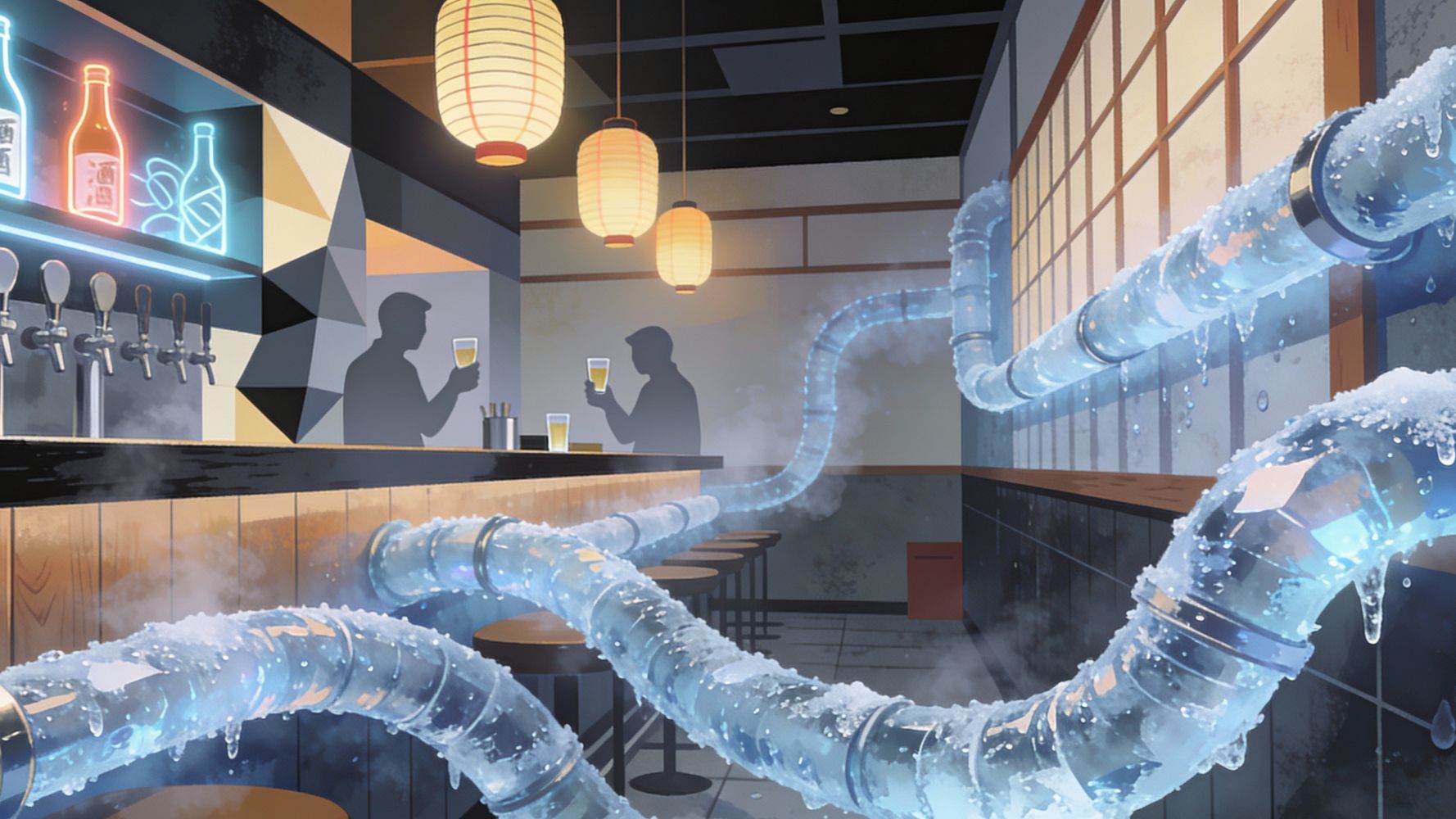
Japan’s beer line cooling systems market is experiencing steady growth, valued at USD 68.6 million in 2026 and projected to reach USD 97.7 million by 2036, reflecting a 3.6% compound annual growth rate (CAGR). This forecast comes from Future Market Insights, Inc., an Indian multinational specializing in global market research and consulting. A key driver is the expanding craft beer segment in Japan, which demands precise cooling to preserve freshness and flavor from keg to taps.
Glycol-based beer line cooling systems account for around 60% of the Japanese market, reflecting operators’ preference for stable, long-draw temperature control. In practical terms, a glycol system is essentially a refrigerator that chills a glycol-water coolant, which is then pumped through insulated lines to wherever the beer needs cooling; glycol is used because it remains liquid at low temperatures and can be circulated over long distances without freezing. Most of the remaining installations rely on simpler air-cooled setups, which work adequately for shorter runs but cannot match glycol systems for consistent pour temperature and quality in more demanding draft configurations.
Restaurants command about 35% of demand for beer line cooling systems in Japan, with the remainder split nearly equally among hotels, bars, and households. Breweries, surprisingly, do not appear in the report’s end-user breakdown by percentage, possibly due to their focus on production rather than dispensing equipment. Emerging trends favor multi-tap configurations and compact, space-efficient systems tailored for Japan’s dense urban venues like izakayas and small eateries.
Japan’s beer line cooling systems are riding a wave of tech upgrades, with manufacturers prioritizing energy efficiency, quieter compressors, multi-zone cooling, and smarter digital monitoring. The push for “quieter” operation will especially amuse anyone who has stood next to an old glycol chiller roaring away in a back room, wondering whether it was cooling beer or preparing for takeoff.
Ultimately, though, whatever system you use for cooling, the real priority is enjoying a cold one today.