

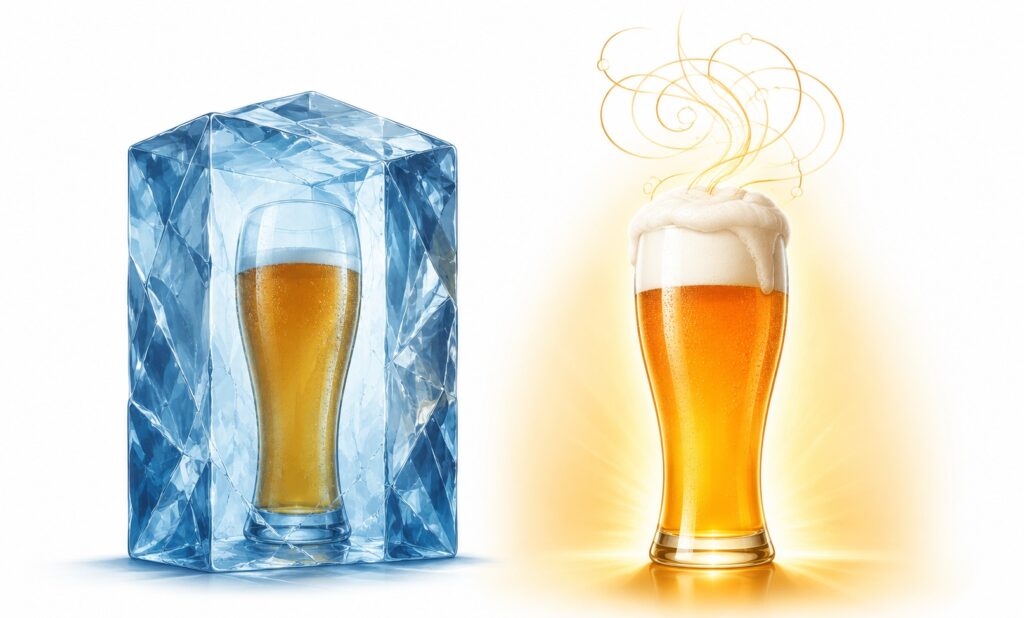
The modern hospitality industry harbors a cold, glassy secret: it is systematically destroying the flavor profile of one of the world’s most intricate beer styles. Walk into almost any contemporary craft beer bar, and you are likely to witness a structural crime disguised as premium service—a traditional Bavarian wheat beer poured directly into a frosted glass pulled from a sub-zero freezer.
This unfortunate practice is a marketing hangover from the macro-lager wars of the late twentieth century. It chemically anesthetizes the drinker’s palate and locks critical aromatic compounds inside the liquid matrix. When a beer engineered for volatile complexity is subjected to a 2°C [36°F] draft line, it loses its identity entirely, transforming an artisanal ale into a rather generic (and over-carbonated) beverage.
To correct this thermodynamic misstep, a strict departure from uniform refrigeration is required. According to the BJCP 2021 Beer Style Guidelines, maintaining the structural integrity of top-fermented wheat styles requires an intentional, style-specific approach.
The Definitive Serving Temperature Matrix
| Wheat Beer Style | Optimal Serving Window | Sensory Justification |
| Bavarian Weissbier / Hefeweizen | 7°C – 9°C [45°F – 48°F] | Volatilizes the essential banana ester to balance the resilient clove phenol. |
| Belgian Witbier | 4°C – 7°C [39°F – 45°F] | Preserves the crispness of raw wheat while allowing coriander and orange peel oils to express. |
| Berliner Weisse / Gose | 4°C – 6°C [39°F – 43°F] | Lighter body and sharp lactic acidity benefit from a lower thermal baseline to maximize refreshment. |
| Dunkelweizen / Weizenbock | 10°C – 12°C [50°F – 54°F] | High-gravity, malt-forward variants require cellar temperatures to unlock rich melanoidin and dark fruit profiles. |
The Macro-Lager Hangover in Modern Service
The custom of serving beer at near-freezing temperature stems from a specific commercial mandate. Light, adjunct-heavy macro lagers are engineered to minimize flavor expression; serving them cold masks structural thinness and suppresses volatile elements that might otherwise present as defects. Unfortunately, this approach has become so universal that it is often unthinkingly used when dealing with complex craft styles.
From a physiological standpoint, extreme cold temporarily numbs the human tongue’s TRPM5 taste receptors, which are responsible for transmitting sweet, bitter, and umami signals to the brain. When a delicate ale hits a mouth chilled by a frosted glass, the palate is physically incapable of deciphering the liquid’s structural nuances. The beer appears refreshing merely because it induces mild thermal shock, not because its flavor profile has been successfully delivered.

The Physical Chemistry of Headspace Volatiles
To understand why serving a Hefeweizen at 3°C [37°F] is a bad idea, we must look to the physical chemistry of gas-phase partitioning. Human olfaction does not engage with the liquid beer directly, but rather with the gas molecules suspended within the glass headspace. The migration of these aroma-active compounds from liquid solution to gas phase is highly dependent on thermal energy.
The signature bouquet of a traditional German wheat beer relies on a precise equilibrium between two volatile organic compounds synthesized by specialized Saccharomyces cerevisiae yeast strains:
- Isoamyl Acetate (C7H14O2): The acetate ester responsible for the characteristic banana and circus-peanut aroma (when mixed with alcohol, it is known as banana oil or pear oil).
- 4-Vinyl Guaiacol: The volatile phenol responsible for the spicy, clove-like, and medicinal notes (this is one of the compounds responsible for the natural aroma of buckwheat, its aroma often described as apple, spicy, peanut, wine-like or clove and curry).
These compounds exhibit drastically different boiling thresholds and partition coefficients. As detailed in a comprehensive review of key beer odorants and off-flavors, volatile phenols are structurally resilient and highly perceptible even at lower temperatures. Conversely, acetate esters are highly soluble in ethanol and require greater kinetic energy to break their intermolecular bonds.
When served straight from a standard commercial walk-in cooler, a Hefeweizen’s ester profile remains suppressed, as documented in technical analyses of volatile ester production in yeast. The drinker perceives only the spicy 4-vinyl guaiacol, rendering the beer uncharacteristically sharp, stark, and medicinal. Only when the liquid warms past the 7°C [45°F] threshold does the isoamyl acetate gain the thermal velocity required to volatilize, establishing the style’s definitive, historical equilibrium.
Furthermore, this aromatic release is mechanically driven by carbon dioxide solubility, which operates under Henry’s Law (roughly, the more strongly a gas is “pushed” against a liquid, the more of it will dissolve into the liquid). As a cold beer slowly warms, CO2 drops out of solution and forms bubbles. Because many desirable esters are hydrophobic, they preferentially attach to the surfaces of these rising bubbles. The bubbles act as miniature elevator shafts, carrying the aromatic molecules upward through the liquid column and projecting them into the headspace as they rupture at the surface. Sub-optimal chilling halts this transport mechanism entirely, as noted in the American Homebrewers Association guide on serving temperatures.
Glassware Engineering: The Thermodynamic Shield
The traditional Bavarian Weissbierglas (wheat beer vase) is not merely an aesthetic choice; it is a highly evolved piece of thermodynamic engineering designed to manage this volatile migration. Its unique silhouette features a heavy, narrow base that transitions into a wide, bulbous top before tapering slightly inward at the rim.

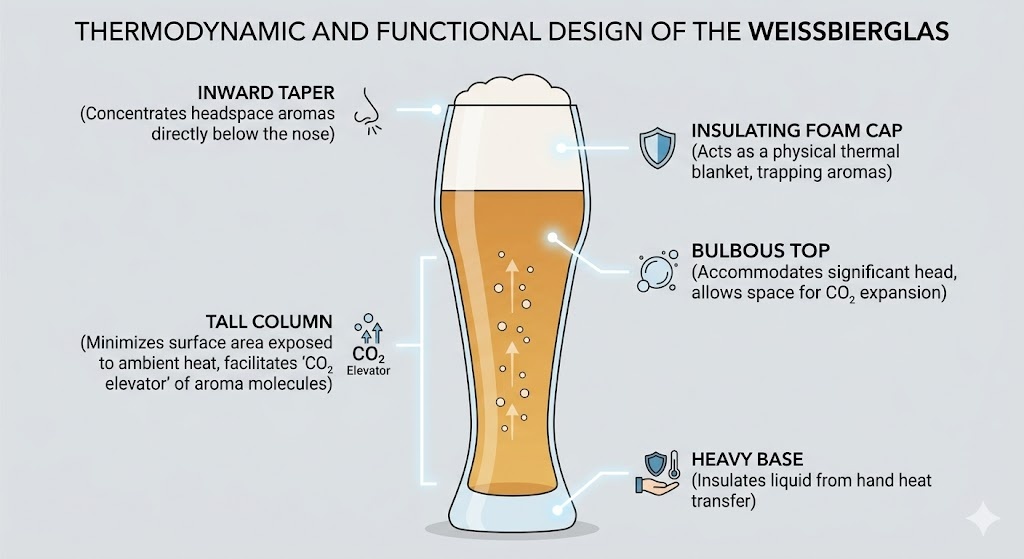
This structural architecture serves several critical functions:
- Thermal Layering: The heavy glass base acts as an insulator against thermal transfer from the consumer’s hand. The tall, narrow column forces the liquid to stay compacted, minimizing the surface area exposed to ambient room temperature and preventing the lower portion of the pour from warming prematurely.
- The Insulating Foam Cap: The bulbous top is explicitly shaped to accommodate a dense, multi-centimeter cap of foam. This foam is vital; it acts as a physical thermal blanket, slowing down the dissipation of carbon dioxide and trapping volatile headspace aromas underneath the rim.
- Headspace Concentration: The gentle inward taper at the very top of the glass captures the escaping esters and concentrates them directly beneath the drinker’s nasal passage during consumption.
Pouring a wheat beer into a frosted shaker pint destroys this mechanical chain of events. The structural rules outlined in the Brewers Association draught beer basics demonstrate that ice crystals on the interior walls of a glass act as nucleation sites, triggering rapid, uncontrolled CO2 breakout that yields a messy, unstable foam cap while flatlining the beer underneath.
Reclaiming the Countertop
For bars and enthusiasts alike, reclaiming the true expression of a wheat beer requires patience. If your commercial draft infrastructure or residential refrigerator is locked to a standard 3°C [37°F] configuration, implement the fifteen-minute rule.
Remove the bottle or pour the glass, and let it sit undisturbed on the counter before service. As the temperature climbs past 7°C [45°F], the chemical transformation will begin. The sharp, medicinal notes will recede, the hydrophobic esters will unlock, and the beer will finally taste exactly as the brewer intended.