
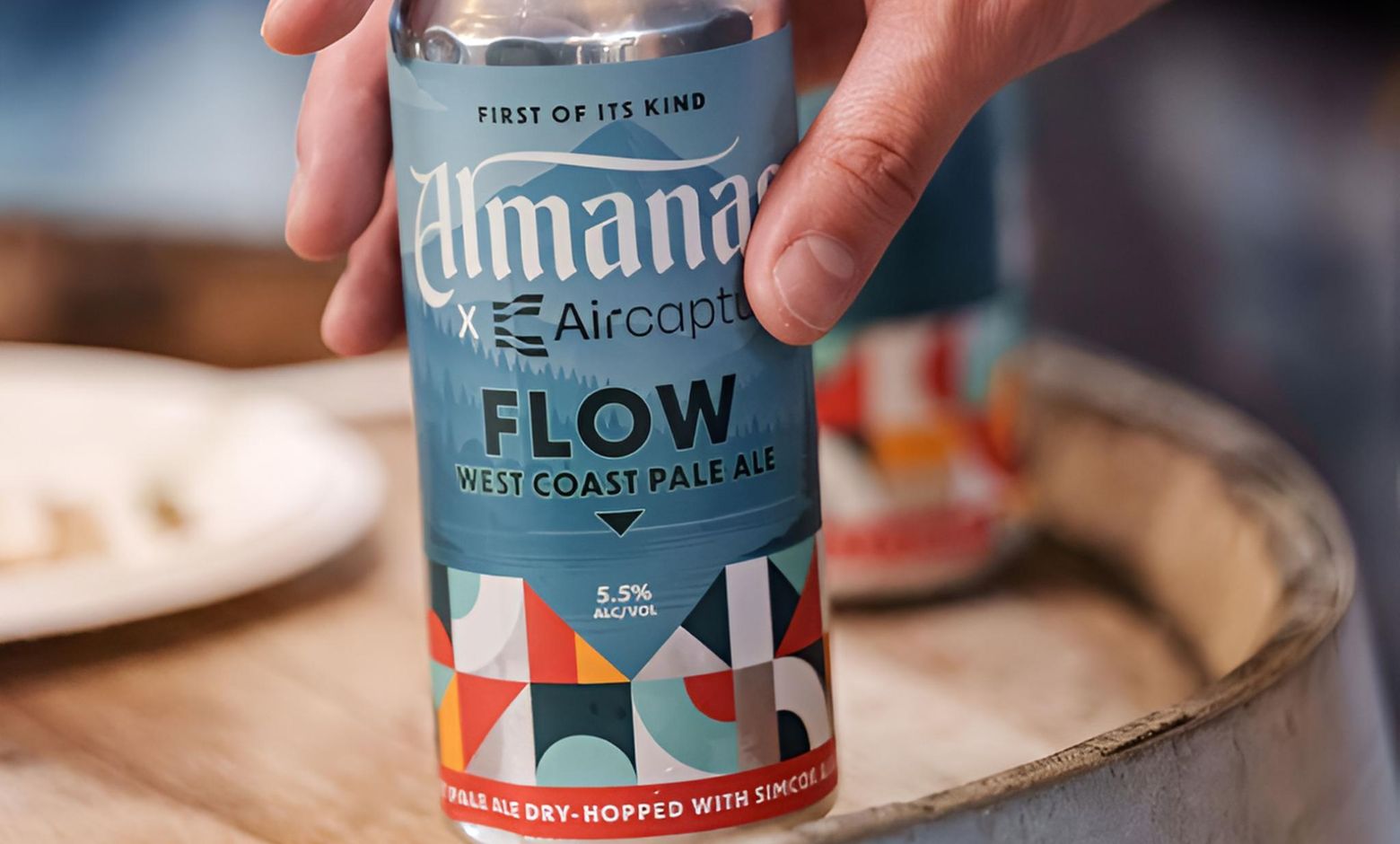
In a move that gives “industrial atmosphere” a surprisingly literal meaning, California’s Almanac Beer Co. has partnered with tech firm Aircapture to release “Flow – Clean Air Edition (Flow – CAE).” While the craft beer world is no stranger to experimental ingredients, this West Coast IPA distinguishes itself by its bubbles: it is the first commercial beer carbonated using CO2 captured directly from the sky.
The process centers on a modular Direct Air Capture (DAC) unit installed at Almanac’s brewery in Alameda. Rather than waiting for carbon dioxide to find its way into the fermenter via natural processes, the machine pulls ambient air through a specialized filter, extracts the CO2, and converts it into a 99.999% pure liquid tailored for brewing.
Breaking the Fossil Fuel Fizz
For the average consumer, carbonation is a given—a mechanical hiss upon opening a can. However, for the brewing industry, CO2 is a volatile commodity. Historically, the gas used to carbonate beer is a byproduct of unrelated industrial processes, primarily ammonia production and the refining of fossil fuels. This leaves brewers tethered to a supply chain that is as carbon-intensive as it is unreliable; shortages are common, and prices often spike when fertilizer plants go offline.
By generating gas on-site, Aircapture provides a “fountain-to-glass” solution that bypasses the traditional supply chain entirely. It transforms a brewery from a passive consumer of industrial waste into an active harvester of its own resources.
Scaling Beyond the Pint
While the Almanac project serves as a high-profile proof of concept, Aircapture’s ambitions extend well beyond the taproom. The company is deploying similar modular units across various sectors where high-purity CO2 is required. Recently, the firm announced Japan’s first DAC plant in collaboration with Mitsubishi Corporation, aimed at decarbonizing cement production—a far more carbon-heavy endeavor than brewing.
The technology represents a shift toward decentralized carbon management, where the gas is captured exactly where it is needed, whether that is in a concrete kiln or a bright tank.
A Toast to Adaptation
The brewing industry is currently fighting a multi-front war against a warming planet. Climate change is already threatening European hop yields, forcing the industry to seek out technological interventions. We’ve seen supercritical extraction methods used to preserve hop terroir in Brazil, and calls for lower-protein barley varieties to compensate for harsher growing seasons.
However, the energy transition remains a “two-tier” struggle. While mega-breweries can afford million-dollar retrofits, independent craft brewers often find themselves priced out of sustainability.
Admittedly, scrubbing the air for a single batch of IPA won’t stop the ice caps from melting. On a brewery-wide scale, the net impact on global carbon levels is more of a polite suggestion than a solution. Yet, the significance lies in the scalability and the precedent. If brewers can turn the very air around them into a reliable, sustainable ingredient, they may find a way to keep the taps flowing even as the climate becomes increasingly uncooperative.