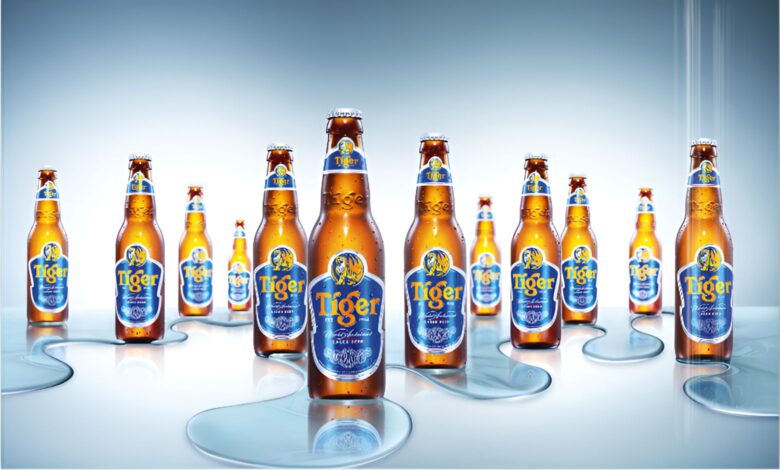
Singapore’s most famous feline is packing its bags—or at least its heavy brewing equipment. Heineken announced this week that Asia Pacific Breweries Singapore (APBS) will officially pivot to an import-led supply model, phasing out large-scale production at its iconic Tuas brewery by late 2027.
The move marks a definitive end to an era for a facility that has defined the West-side skyline for decades. While the “Home of Tiger Beer” will technically remain in Singapore, the actual liquid will soon be commuting across the border from regional hubs in Malaysia and Vietnam.
Tiger Beer was launched in 1932 as Singapore’s first locally brewed lager. The brand was the flagship product of Malayan Breweries Limited, a joint venture between local soft-drink producer Fraser and Neave (F&N) and the Dutch brewer Heineken. Specifically formulated to maintain quality in the heat and humidity of Southeast Asia, the lager utilized a process known as “tropical lagering.” Over nine decades, Tiger expanded its footprint from a colonial-era novelty to a global brand distributed in over 60 markets.
The Death of the Tuas Tap
The decision isn’t a retreat, but a “disciplined execution” of Heineken’s EverGreen 2030 strategy. In corporate parlance, “EverGreen” is the roadmap for keeping the world’s second-largest brewer agile in a volatile market. In practical terms for Singapore, it means realizing that real estate in the Lion City is perhaps too precious for the industrial-scale clinking of glass bottles.
By 2027, the Tuas site will transition from a high-output factory to a high-tech “Regional Hub.” It is a move that mirrors Singapore’s broader economic trajectory: moving away from the “sweaty” work of manufacturing toward the air-conditioned prestige of “regional coordination.”
Silicon Valley in a Pint Glass
Under the new model, the Tuas site will be redeveloped into a center for regional logistics and innovation. Most notably, Heineken plans to double down on its “global GenAI Lab” in Singapore.
It is a pivot that feels remarkably on-brand for the current decade. Had this announcement dropped in 2021, we surely would have been reading about “Blockchain-verified lagers” and “NFTiger” collectibles. Today, the buzzword of choice is Generative AI, which Heineken claims will support productivity and decision-making worldwide.
This is the kind of “helicopter thinking” we’ve come to expect from the green giant lately. It’s a corporate worldview that prioritizes high-level optimization over traditional substance—much like their recent quest for the “Holy Trinity of Nothing” with the 0.0 Ultimate launch. Whether an algorithm can truly replicate the specific humidity-induced thirst that makes a Tiger taste good remains to be seen, but the “pilot brewery” staying behind at Tuas will likely be where the robots and humans meet to test the theory.
The Aftertaste
Ultimately, this shift solidifies Singapore’s role as the “brain” of Heineken’s Asia Pacific operations, even as it ceases to be the “muscle.” The global leadership for Tiger Beer—the strategy, the creative direction, and the R&D—will stay firmly anchored in Singapore.
For the average consumer, the label might soon say “Imported,” but the marketing will insist the soul remains local. As the last large-scale batches roll off the Tuas line over the next three years, purists may claim they can taste the difference, but Heineken is betting that as long as the brand is “Born in Singapore,” the world won’t mind if it’s actually “Raised in Vietnam.”