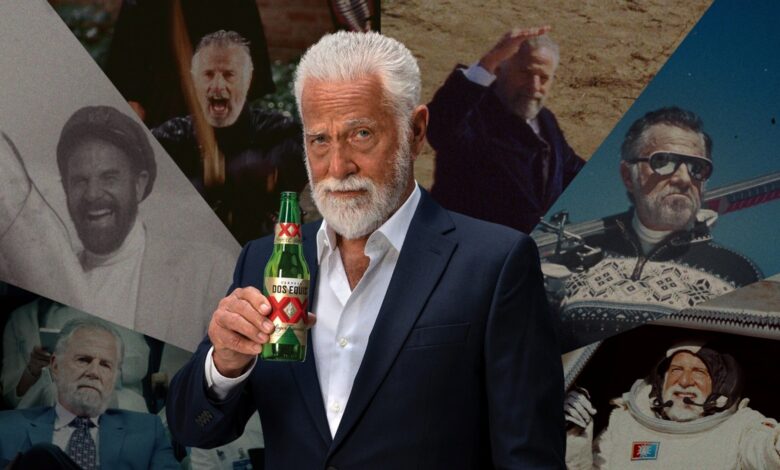
In an era where brand authenticity is often measured by the quality of one’s comment section, Dos Equis is taking the logical—if slightly cynical—next step. The Heineken USA-owned brand has officially invited the public to write the next chapter of its most iconic campaign, launching a nationwide search for the “Most Interesting Comment in the World.”
The initiative asks fans to submit their own “legend lines”—those hyperbolic, deadpan descriptors that transformed actor Jonathan Goldsmith into a permanent fixture of meme culture between 2006 and 2016. After reviving the character in January, the brand is now looking for three “citizen copywriters” whose quips will be featured in national television commercials during the 2026 College Football season.
Reversing the Slump
This “emergency nostalgia” lever was pulled following a lackluster 2025, where retail sales for Dos Equis slipped 8%—a decline far sharper than the 2% dips seen by rivals Modelo and Corona. The pivot appears to be stabilizing the ship; according to Heineken’s Q1 2026 Trading Update, the “Premium” segment grew by 5.8% globally. While this isn’t hard, isolated data for the brand, it suggests the return of Goldsmith is successfully re-engaging the American consumer’s “memory levers.”
The b33r.xyz Take: Marketing to Ourselves
While community engagement is a sound strategy for boosting organic reach, there is a growing sense that corporations would prefer if we simply marketed their products to ourselves for free.
We are seeing this “Do It Yourself” (DIY) advertising model with increasing frequency. It mirrors the approach taken by Brewlander’s recent prompt-only campaign, which leaned on generative AI and community input under the guise of being “cost-effective.”
While Dos Equis is offering “perks”—including a meal with Phil Rosenthal, VIP tour access for Fuerza Regida, or a luxury college football tailgate—the underlying economics remain the same. By formalizing fan discourse into a creative pipeline, the brand effectively lowers its creative overhead and secures a “Boaty McBoatface” level of engagement without the traditional agency price tag.
If the goal of advertising is to make a product feel like a part of the consumer’s identity, there is no more efficient way to do it than by having the consumer write the script. Whether this leads to a genuine creative renaissance or just a more polished version of a 2012 Twitter thread remains to be seen.