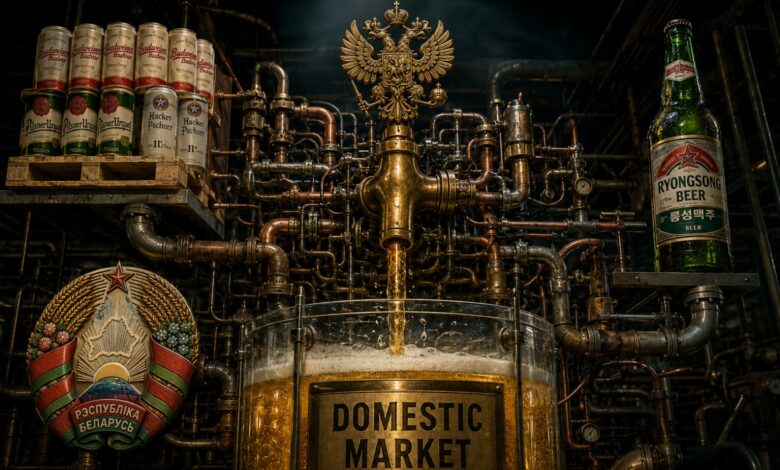
Russia has found a highly lucrative—and entirely legal—loophole to keep European beer flowing into the country, and the route runs directly through Minsk. According to data from the Russian Union of Cognac, Spirit, and Alcoholic Product Producers recently reported by Nasha Niva, Belarus has become the primary transit corridor for imported beer into the Russian Federation. From January to April 2026, a staggering 81 million liters of beer passed through Belarusian territory, accounting for over 60 percent of Russia’s total 135 million liters of imported beer. This marks a massive 167 percent increase in supply volume compared to the same period last year.
This dramatic surge in logistics traffic is the direct result of diverging customs policies within the Eurasian Economic Union (EAEU). In January 2025, Moscow drastically hiked customs duties on beer originating from “unfriendly countries” tenfold, pushing tariffs from €0.1 to €1 per liter, before increasing them further to €1.5 per liter. However, because Belarus is a fellow EAEU member state, these punitive unilateral tariffs do not apply to goods cleared through its customs infrastructure. Instead, importers pay standard, significantly lower EAEU base tariffs in Minsk before moving the cargo across the border, effectively bypassing Moscow’s protectionist barriers. It proves once again that where there is a market thirst, a regulatory workaround is rarely far behind.
European brands traveling through diplomatic side-streets are not the only ways Russia is keeping its retail shelves stocked, however. When Western supply chains become overly complex or restricted, Moscow has shown a willingness to look toward alternative trade partners to fill the void. As previously analyzed in b33r.xyz’s report on North Korea’s export arsenal, Russia has increasingly turned to Pyongyang for liquid sustenance, importing brands like Ryongsong beer to satisfy domestic demand. Between dodging tariffs on European lager via Minsk and importing North Korean state-brewed pilsners, Russia’s supply chain strategies are becoming a masterclass in macroeconomic acrobatics.
For the time being, neither Russian nor Belarusian customs authorities have signaled any intent to harmonize their tariff structures or close the Minsk loophole. As long as the paperwork clears and internal borders remain open within the EAEU, Belarus will maintain its status as Russia’s premier backchannel for foreign beer.