
The Brewers Association (BA) is urging the American Malting Barley Association (AMBA) to update its breeding standards to prioritize lower protein levels. As climate change drives protein concentrations higher, brewers are finding it increasingly difficult to produce the stable, high-quality beer consumers expect. The BA is requesting a shift in focus toward “all-malt” brewing needs rather than outdated standards designed for adjunct brewing.
The Brewers Association is a 501(c)(6) not-for-profit trade organization that represents small and independent American craft brewers. It serves as a technical and political advocate for the industry, managing quality standards, beer style guidelines, and major industry events like the Great American Beer Festival. Because the BA represents the majority of the nation’s craft breweries, their technical recommendations—such as these barley protein targets—set the quality benchmarks for the raw materials used by growers and maltsters throughout the supply chain.
The Shift from Adjunct to All-Malt Standards
Historically, barley breeding standards were designed to support “adjunct” brewing, a method used by large-scale commercial breweries that involves adding non-malt sugar sources like corn or rice. Because these adjuncts contain almost no protein, brewers actually required high-protein barley to provide enough enzymes and nutrients to process the extra sugars. However, the modern craft beer industry focuses primarily on “all-malt” brewing. In an all-malt environment, the enzymes provided by the barley are already sufficient; when the barley itself is also high in protein, it results in an excess that the brewing process cannot easily absorb, leading to quality and stability issues.
The Climate Challenge: Why High Protein is Bad for Your Pint
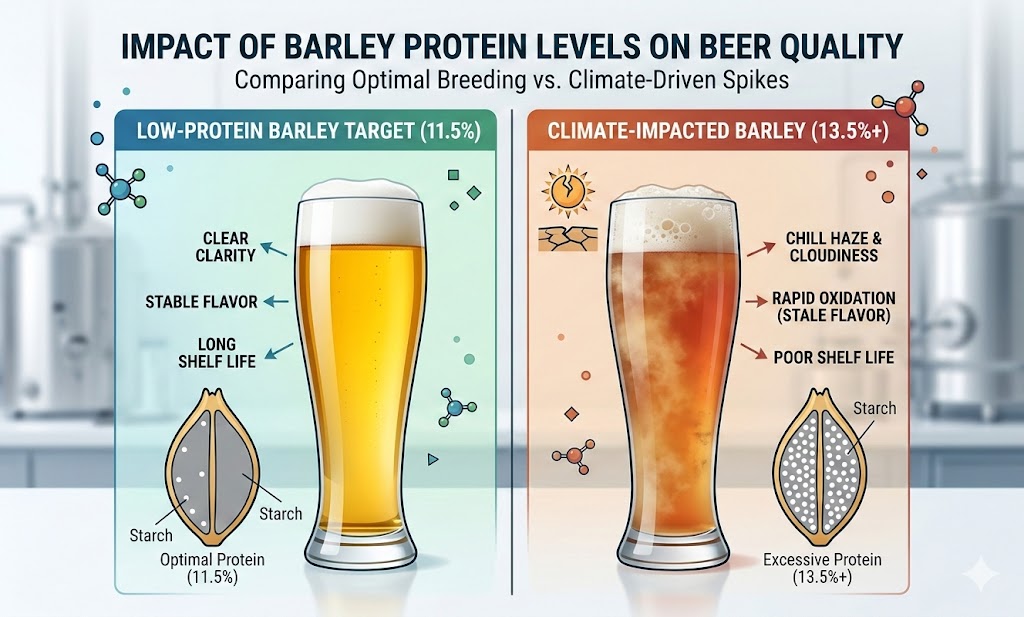
Barley protein is heavily influenced by environmental stress. As global temperatures rise and droughts become more frequent, barley plants experience shorter growing windows and moisture stress. Under these conditions, the plant focuses on concentrating nitrogen (protein) in the grain rather than producing starch. Essentially, the harsher the weather, the higher the protein content becomes.
While a small amount of protein is necessary for foam and body, excessive levels create technical hurdles. High-protein barley often leads to:
- Haze Issues: Excess protein causes “chill haze” or permanent cloudiness in styles intended to be crisp and clear.
- Flavor Instability: High protein levels are linked to faster oxidation, which can cause beer to taste “stale” or like wet cardboard much sooner than intended.
- Higher Costs: Brewers must often use more complex processing techniques to manage high-protein malt, which can increase production costs.
The challenge of rising barley protein is not unique to North America; European brewers are facing similar “climate-driven quality shifts.” In the EU and UK, where more than 60% of the world’s malting barley is grown, extreme heatwaves and droughts—particularly in Southern Europe and Eastern England—have already caused protein spikes and yield penalties of up to 30% in recent years. While the European Brewery Convention (EBC) has long maintained a slightly different technical range for malt quality, the industry is now moving toward a massive research effort to identify “climate-resilient” cultivars. European organizations are increasingly focused on New Genomic Techniques (NGTs) and advanced breeding to ensure that barley can survive warmer winters and drier summers without sacrificing the low-protein profile required for traditional European lagers and ales.
Barley is not the only ingredient under threat; climate change is forcing a total rethink of how beer ingredients are processed to maintain quality. For example, in warmer regions like Brazil, producers are utilizing supercritical extraction methods to preserve hop quality and terroir that would otherwise be degraded by rising temperatures.
The BA is proposing a “New North” for barley breeding. This involves lowering the target protein level to 11.5% (down from the current 12.0%+) and adjusting other technical metrics like Free Amino Nitrogen (FAN) and beta-glucan. By shifting breeding goals now, the industry can develop “climate-hardy” barley varieties that can withstand heat and drought while still maintaining the low protein levels required for stable, high-quality craft beer.