One Last Call for the Gusto: Schlitz Beer Discontinued After 177 Years
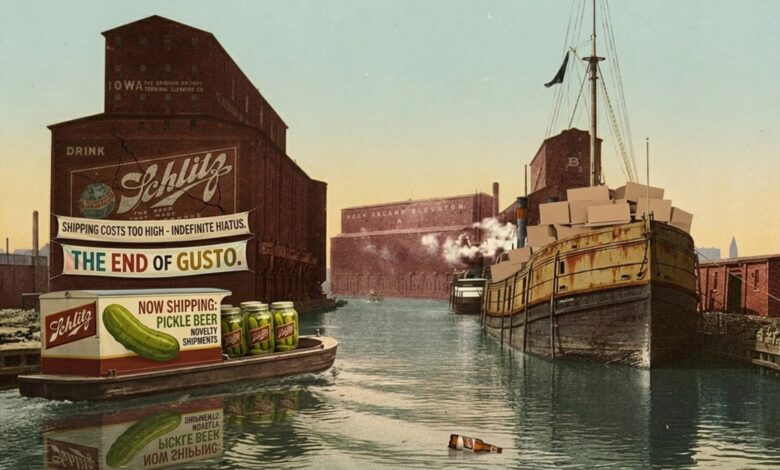
It appears the world has officially run out of gusto. Pabst Brewing Company, the current custodian of the historic brand, has announced it is officially discontinuing Schlitz, bringing a formal end to the 177-year-old American legacy.
According to Pabst, the decision to place Schlitz Premium on “indefinite hiatus” comes down to the unromantic realities of modern logistics. Rising costs associated with storing and shipping the lager simply made it economically unfeasible to continue national distribution. However, die-hard fans will get one literal final round. Wisconsin Brewing Company has been tapped to brew a final, limited commemorative batch using a composite of mid-20th-century archived recipes, which will go on sale for pre-order ahead of a formal farewell event in June. After that, “the beer that made Milwaukee famous” will reside strictly in the history books.
It is a quiet, corporate end for a brand that once sat atop the global brewing empire. Founded in 1849 by August Krug and later spearheaded by bookkeeper-turned-mogul Joseph Schlitz, the Joseph Schlitz Brewing Company didn’t just capitalize on Milwaukee’s brewing boom—it defined it. Following the Great Chicago Fire of 1871, which devastated Illinois breweries, Schlitz famously stepped in to send a massive influx of beer south, effectively solidifying its status as a savior to parched Midwesterners and cementing its legendary slogan.
By the early 20th century, Schlitz routinely fought Anheuser-Busch for the crown of the world’s top-selling beer, holding the number-one spot for significant stretches of the 1940s and 1950s. At its zenith, the massive Milwaukee brewery complex operated like a small city, outputting millions of barrels annually to global markets.
Unfortunately, being on top left the brand with a long way to fall. A series of disastrous management choices in the 1970s—including altering the traditional recipe to accelerate fermentation, which inadvertently led to a hazy appearance and a tendency to form flakes in the can—permanently ruined its reputation among working-class drinkers. Combined with a notorious, aggressive marketing campaign that consumers interpreted as borderline threatening, the brand never recovered. It closed its flagship Milwaukee brewery in 1981, bounced around various parent companies, and was ultimately acquired by Pabst in 1999, where it lived on primarily as a nostalgia play for the budget-conscious.
The death of Schlitz highlights a curious shift in the modern beverage landscape. While Pabst has deemed a historic, traditional lager too expensive to ship, the company has shown plenty of willingness to experiment with the avant-garde. Pabst recently turned heads in the craft and macro spaces by launching highly specific novelty offerings, most notably its distinctive Pickle Beer.
The departure of Schlitz highlights a broader, more complex evolution in consumer behavior and beverage marketing. While a historic, traditional lager faces logistical hurdles in national distribution, its parent company has found success leaning into the avant-garde, most notably with the recent launch of its highly publicized Pickle Beer. This contrast raises questions about the changing nature of brand loyalty. It suggests that the modern palate may be less tethered to historical pedigree and more drawn to experiential, unexpected flavor profiles—even those reminiscent of a deli side dish. As classic legacy brands quietly recede under the pressures of modern supply-chain margins, they leave behind a landscape increasingly defined by viral trends and novelty. For Schlitz, the final whistle marks the end of an era, serving as a reminder that in the volatile beverage market, even the beer that made Milwaukee famous must eventually make way for the next wave of innovation.