
Climate change is coming for your weekend pint, and it is not going to be pretty. Rising global temperatures and prolonged droughts are wreaking havoc on traditional hop-growing regions across Europe and North America. For beer lovers, the crisis is twofold: climate volatility is shrinking overall hop yields while simultaneously degrading the delicate alpha acids and essential oils that give beer its signature bitterness and aroma. Without a drastic intervention, the future of brewing looks remarkably bland.
Enter the scientists. In a major breakthrough published today in Nature Communications, researchers from the Carlsberg Research Laboratory, in collaboration with Helmholtz Munich and industry giant Hopsteiner, have successfully mapped the incredibly complex genetic code of hops (Humulus lupulus). It is a high-resolution DNA roadmap that might just preserve the future of beer in a warming world.
The Genomic Architecture of a Hybrid Headache

Unpacking the hop genome has historically been a geneticist’s nightmare. The plant’s genome is massive, highly repetitive, and notoriously difficult to sequence. To complicate matters, hops are dioecious—meaning male and female flowers grow on entirely separate plants, though only the female cones possess the lupulin glands prized by brewers.
The new study solves a massive piece of this puzzle by providing a chromosome-level assembly that separates the maternal and paternal chromosomes within a commercially critical hop variety. In doing so, the researchers laid bare a deep evolutionary divide. Modern commercial hops are complex hybrids built from two highly divergent lineages: European and North American.
While both lineages possess traits that brewers covet, the Nature paper highlights a major bottleneck: because the European and North American lines are so genetically distinct, structural variations between their chromosomes make natural genetic recombination incredibly difficult. It is an evolutionary mismatch that has long stymied traditional breeding programs.
To make sense of this tangled genetic web, the researchers utilized comparative genomics, drawing structural parallels to the hop’s close evolutionary cousin, Cannabis sativa. This approach gives scientists a broader comparative and evolutionary context, building on earlier milestones in Cannabaceae research. Indeed, as previously covered in b33r.xyz, unraveling the genetic secrets of cannabis has consistently paved the way for breakthroughs in the hop yard.
Armed with this data, the authors suggest a entirely new playbook for hop breeding. Instead of battling the structural incompatibilities of cross-continental hybrids, breeders can use this genetic map to execute highly targeted strategies. For instance, the authors propose developing new hybrid lines by deliberately crossing distinct, structurally compatible European lineages, or using the map to precisely track and preserve specific climate-resilient chromosomal segments during breeding.
Open-Source Genetics for the Future of the Pint
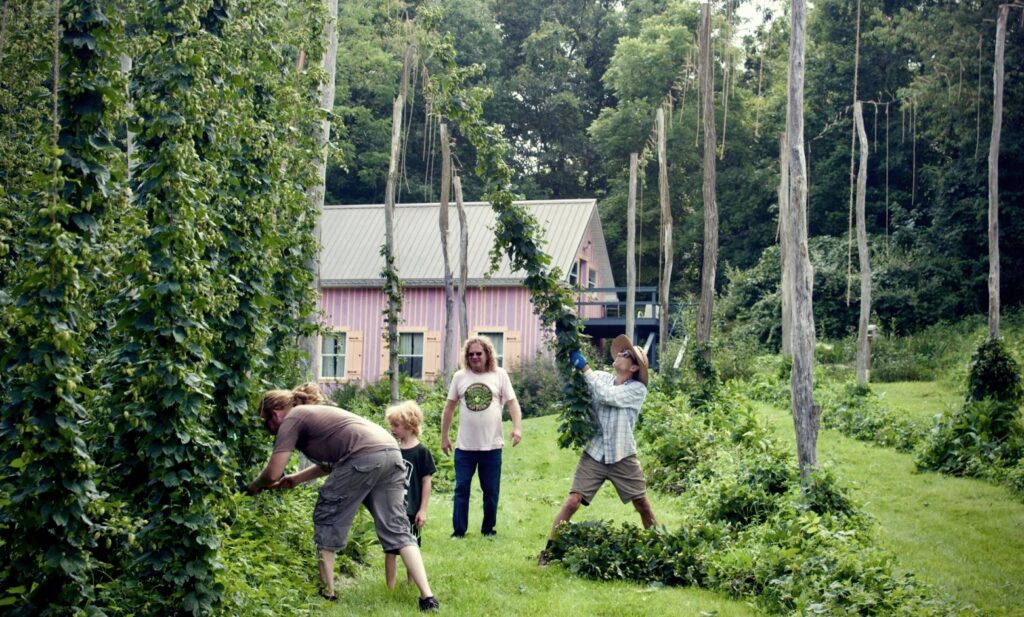
Developing a new hop variety through traditional trial-and-error breeding is a grueling process that typically takes upwards of a decade—a timeline humanity can ill afford as global temperatures climb. This high-resolution genetic blueprint effectively cuts the clock, allowing breeders to bypass decades of guesswork and fast-track plants engineered to survive harsher, hotter climates without sacrificing flavor.
In a move that mirrors the open-science ethos of the early tech movement, Carlsberg has made this genomic data entirely open-source. According to Birgitte Skadhauge, Vice President of the Carlsberg Research Laboratory, the threat of climate change requires global collaboration, stating that the challenge is simply “bigger than any one company.”
With this publication, the Carlsberg Research Laboratory completes a scientific triple crown for the brewing industry. Having previously contributed landmark public genome sequencing for both barley and yeast, the lab has now mapped all three of the core biological pillars of beer.
By giving the global scientific and farming community free access to the hop genome, the research ensures that craft brewers and macro-breweries alike will have the agricultural ammunition needed to fight climate change. Corporate altruism is rare, but when it directly prevents the starvation of the global beer supply, it is a gesture we can all toast to.