The “New Normal” Is a Moving Target: Craft Beer’s Year of Correction
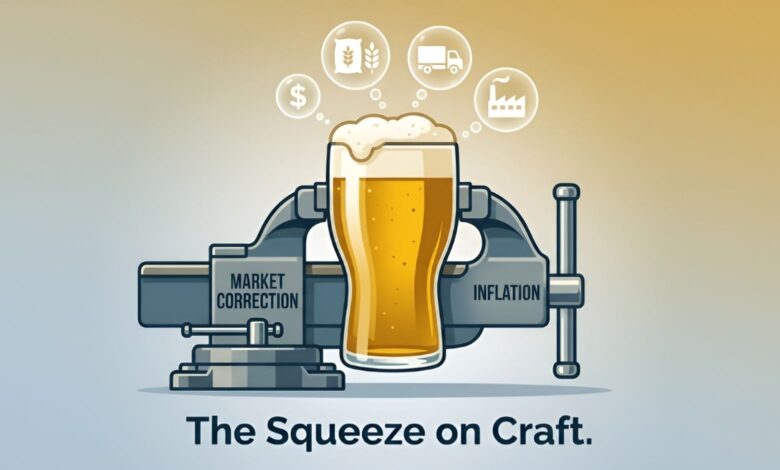
It’s been a sobering year for the American craft beer industry—and not just because of the rising price of a pint. The Brewers Association (BA) recently released its year-end report, characterizing 2025 as a “year of correction.” After a decade of dizzying growth that made it feel like every vacant garage in America was destined to become a taproom, the industry is finally hitting the brakes and checking its vitals.
By the Numbers: Less Liquid, Higher Stakes
The data reveals a sector that is shrinking, albeit with some stubborn resilience. Total craft production volume saw a 5.1% decline, a figure that sounds grim until you look at the wider tap: the overall beer category slumped even further, declining 5.7% by volume.
Because craft fell slightly less than its “big beer” counterparts, its share of the total beer market by volume actually increased a hair, moving from 13.2% to 13.3%. However, as we’ve previously noted, in an era where the term “craft” has been stretched thinner than a light lager, these marginal gains in market share feel more like a statistical quirk than a victory lap. Without clear, rigid definitions, “craft” is often more of a marketing vibe than a production standard.
The financial “correction” was felt most acutely in the ledger and the breakroom. Craft beer’s retail dollar value declined 3.6% year-over-year—a drop that would have been steeper if not for price increases masking the lower volume of sales. This contraction trickled down to the people and the places making the brew: the industry workforce declined by 4%, and the number of operating U.S. craft breweries fell by 2.9%, marking a rare retreat for a formerly exploding sector.
The Power of the Pub
If there is a silver lining in the BA report, it’s found in the taproom. Hospitality-driven models—breweries that focus on selling beer over their own counters rather than fighting for shelf space in a crowded grocery store—remain remarkably resilient.
This mirrors a trend observed in the UK, where the traditional pub continues to hold its market share despite economic headwinds. It turns out that beer is more than just fermented liquid; it’s a social lubricant and a community anchor. In a world of digital fatigue, consumers are still willing to pay for a physical experience they can’t replicate via a delivery app.
Seeking the Meaningful
According to the Brewers Association, the era of “growth for growth’s sake” is officially over. Success in the coming years will be less about distribution footprints and more about brand identity.
Matt Gacioch, staff economist at the Brewers Association, sums up the current state of flux:
“While it’s probably premature to say the industry has settled into a ‘new normal,’ there are many indications that we are moving in that direction. What’s nearly guaranteed is that success going forward will come down to creating something meaningful and memorable for consumers. Breweries that deliver consistent quality, human connection, and unique experiences will stand out.”
For brewers, the directive is clear: be more than just a brand on a tap handle. The momentum now belongs to those who can differentiate themselves in a saturated market. For the rest of us, it means the “correction” might actually be a good thing—fewer mediocre IPAs on the shelf and more reasons to actually walk into a taproom and meet the person who brewed the beer.