Slow Pour: UK Beer Market to Tap $35 Billion by 2032
The British beer market is many things—historic, culturally central, and occasionally rowdy—but “explosive” is rarely one of them. According to a new study by Vyansa Intelligence, the UK beer market is projected to reach approximately $35.3 billion by 2032.
While that is a staggering amount of currency flowing through the taps, the growth rate is a steady, almost leisurely 1.03% CAGR (Compound Annual Growth Rate) between 2026 and 2032. To put that in perspective, the global beer market is currently sprinting at a 7% CAGR. It’s a classic symptom of a “mature” market: British consumers aren’t discovering beer for the first time; they are simply refining how they spend their pounds on it.
The Pub is Still the Office
In an era of digital escapism and rising “at-home” consumption elsewhere, the British pub remains remarkably resilient. The report notes that on-trade establishments—the bars, pubs, and restaurants that define the local high street—account for 60% of the market share.
The social experience remains the primary driver of consumption, though the economics behind the bar remain high-wire. As we’ve noted before, while consumers are happy to pay for the “ambiance,” breweries and publicans are increasingly squeezed by overheads. It is a landscape of pint-sized savings versus mega-brewery millions, where simply turning off the extra lights can be the difference between a profit and a loss.
Lager’s Iron Grip (With a Sober Twist)
Lager continues to be the undisputed king of the British cooler, commanding a massive 65% of the total market share. However, the type of lager is shifting. Standard pints are losing ground to premium and imported variants as drinkers adopt a “drink less, drink better” mantra.
Parallel to this is the meteoric rise of low and non-alcoholic beer. This is no longer just a niche for the designated driver; it is a lifestyle choice backed by high-profile marketing. This trend is accelerating with the likes of Tom Holland’s Bero brand, proving that the social experience of the pub can be maintained without the alcohol content.
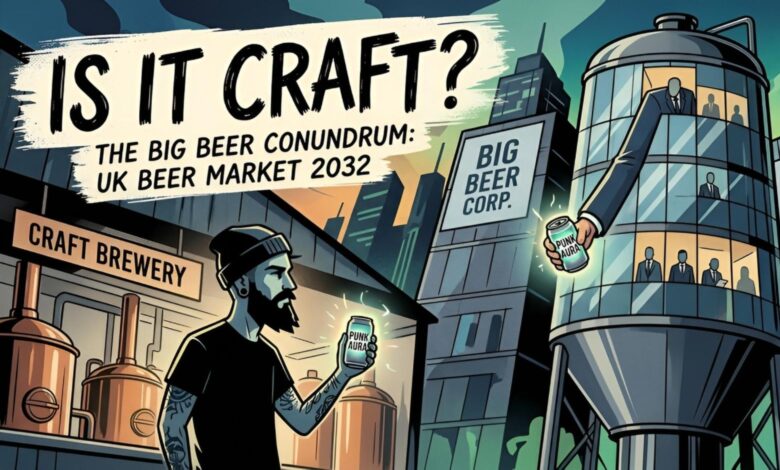
Can “Big Beer” Stay “Craft”?
The competitive landscape in the UK is becoming increasingly top-heavy. The top five companies—including Heineken UK Ltd, Molson Coors, CKA Holdings, Sharp’s Brewery, and BrewDog plc—collectively control about 60% of the market share.
The inclusion of BrewDog in this heavy-hitter list highlights a shifting industry identity. Now part of the global power structure and recently acquired by cannabis giant Tilray, the “punk” brewery raises a perennial question: can you be “Big Beer” and “Craft” simultaneously? As the Vyansa report suggests, the “craft” label remains a massive competitive advantage, but as the lines between independent microbreweries and multinational subsidiaries blur, the term is increasingly used as a marketing aesthetic rather than a brewing philosophy.
For now, the UK market looks like a slow-burning success story—less of a frantic shot of tequila, more of a long, measured sip of a premium pilsner.