
A crushing majority of people believe they possess impeccable personal style, yet almost no one has the courage to express it publicly. That is the central finding of “A Question of Good Taste,” a global sociological study conducted on behalf of French beer brand 1664, a prominent label within the Carlsberg Group portfolio. The research was commissioned to anchor a broader promotional push from Carlsberg Group, which focuses heavily on the themes of taste and personal preference in modern culture.
The data highlights a glaring disconnect between perceived individuality and actual behavior. While 83 percent of respondents insist they have good taste, only 31 percent can actually agree on what that concept means. This collective uncertainty has triggered a culture of profound self-censorship, with 82 percent of those surveyed stating it is simply more polite to withhold their personal opinions around new acquaintances.
Social survival now apparently hinges on blending into the background. The study reveals that 67 percent of people find it easier to “go with the flow,” while 52 percent prefer to entirely avoid debating cultural or societal issues. Paradoxically, this widespread timidity coexists with a deep desire for openness; 77 percent of respondents simultaneously maintain that society would improve if people were more honest about their convictions.
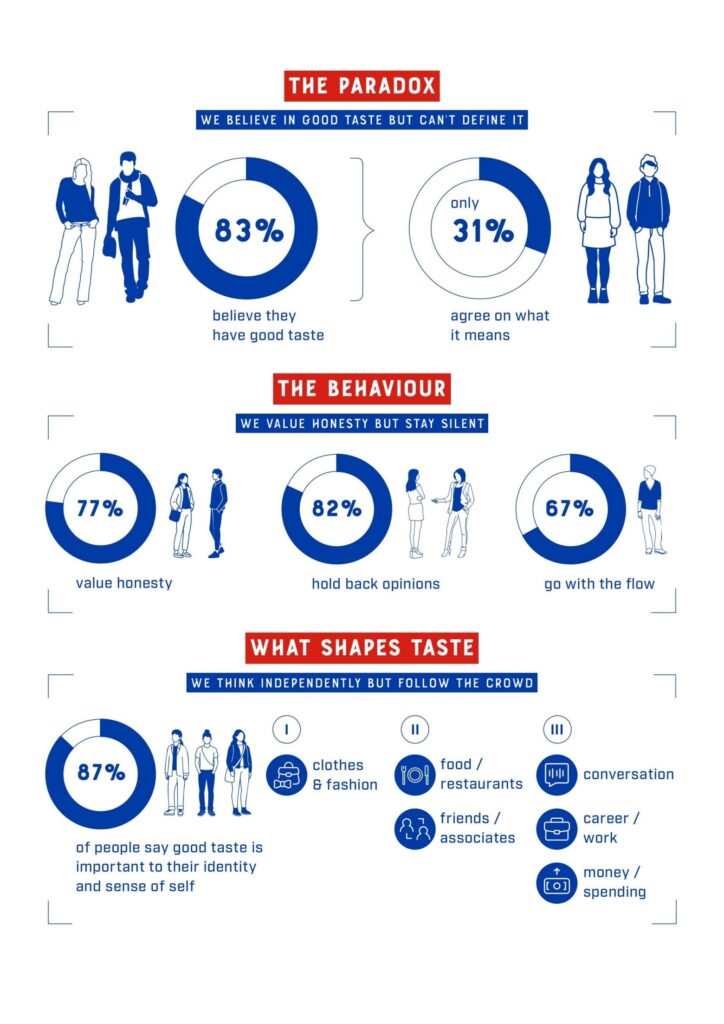
The pressure to conform is heavily reinforced by modern technology. Artificial intelligence and online algorithms have increasingly stepped in to dictate identity, establishing a feedback loop of predictable choices. While more than half of the respondents admit that algorithms make it easier to develop their preferences, 47 percent explicitly state that AI already curates their tastes in film, music, and fashion.
This algorithmic curation has left consumers deeply skeptical of their own digital environments. Nearly 77 percent of participants report that AI makes it difficult to discern what is genuine or honest. Nevertheless, a stubborn 81 percent hold onto the belief that good taste remains a fundamentally human quality, even as they outsource their daily aesthetic decisions to code.
The campaign ties these findings directly into the brand’s creative output, featuring global brand ambassador Robert Pattinson advocating for individuality. By framing the defense of personal preference as a “quietly radical” act, Carlsberg Group attempts to elevate the product from a standard beverage to a champion of cultural authenticity. The strategy reflects an ongoing trend in the beverage industry, where companies increasingly rely on high-minded sociological commentary to foster consumer loyalty in highly saturated markets.